Lesson 14 of 158 min read
Hiring, software and growing past one rig
When to hire your first technician, what to pay, employee or contractor, training, picking bin cleaning software, adding a second rig, and the numbers to watch.
At some point the route gets bigger than you. Growing a bin cleaning business means three things: putting someone else on the route, running it on software instead of your memory, and adding a rig only when the customers are already there. Nobody has published measured data on when to do each one, so this lesson gives you the rules of thumb operators use and the numbers to watch.
When to hire your first technician
The published rules of thumb:
- When revenue and hours say so. One business guide suggests hiring once you’ve grossed $12,000 to $15,000 a month for three straight months and worked 45-hour weeks for two or three months. It also suggests adding a second service day before adding payroll (30DayPivot).
- When you should be selling instead of driving. Another guide puts it at about 150 customers in a tight area: hire someone to run the route so you can sell (MoneyPantry).
- When the route covers the wage. An equipment seller points out that at about $20 an hour all-in, a few stops a day cover a driver’s pay (Garbage Can Cleaning).
A simple test: if you’re turning down customers, or your marketing has stopped because you’re on the route every day, it’s time.
What to pay
Bin cleaning job ads in 2026 paid about $16 to $22 an hour. A Miramar, Florida ad offered $700 a week for 30 to 35 stops a day, about 7:30 am to 2 pm, five days a week (CareerBuilder). The cost to you is more than the wage: one guide estimates a $20-an-hour helper costs $22 to $23 an hour after payroll taxes and insurance.
Employee, not contractor
The IRS looks at who controls the work, the money and the relationship (IRS). You set the route, the method, the rig and the uniform, so a route technician is almost always a W-2 employee, not a 1099 contractor.
- Per-stop or day-rate pay is allowed, but overtime still applies past 40 hours a week: add up the week’s pay, divide by the hours worked, and that rate can’t fall below minimum wage (Department of Labor).
- Paperwork: an I-9 and a W-4 from every hire (IRS).
- Workers’ comp: required from the first employee in 33 states and DC (Lesson 4).
- OSHA: a written hazard communication program and chemical training on day one (OSHA).
Who to hire
The Miramar job ad asked for:
- a valid driver’s license and a clean driving record;
- age 25 or older;
- comfort with a tablet for the route and photos;
- repetitive lifting, bending and climbing.
Add the ability to talk to customers politely; the same ad asks drivers to represent the company and keep complaints down.
Train with checklists
Write your checklists before you hire. Two business guides list hiring before documenting the work as a common mistake.
Train on:
- The stop, step by step (Lesson 8).
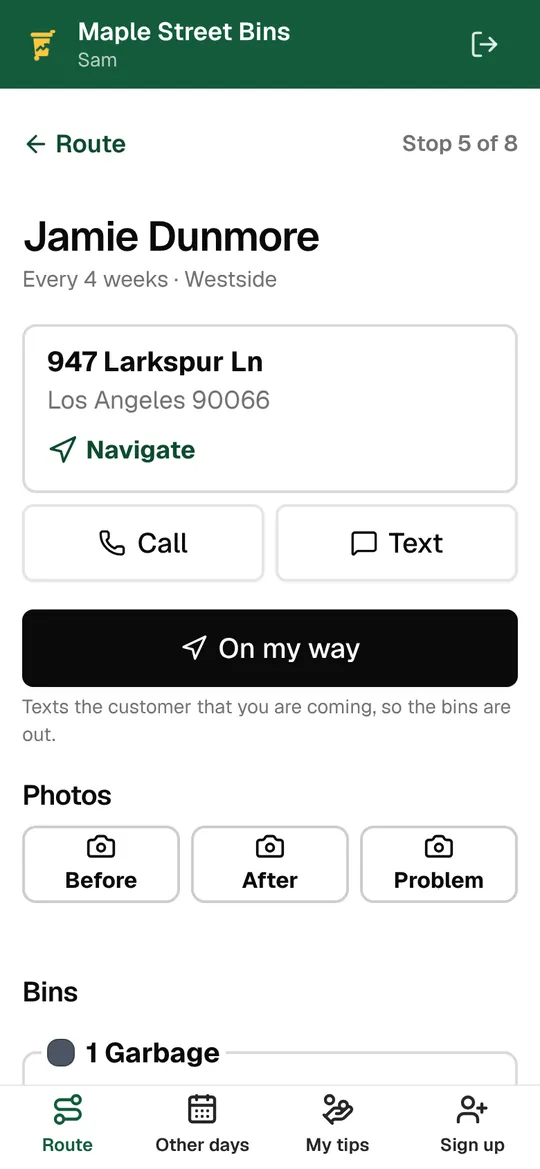
- Photos and results in the app: Cleaned, Not out, Blocked, Damaged, with a note.
- Your missed-bin and damage rules.
- Safety: high-visibility clothing, the curb side, the lift, chemicals and their safety data sheets, needles, heat.
- Talking to customers.
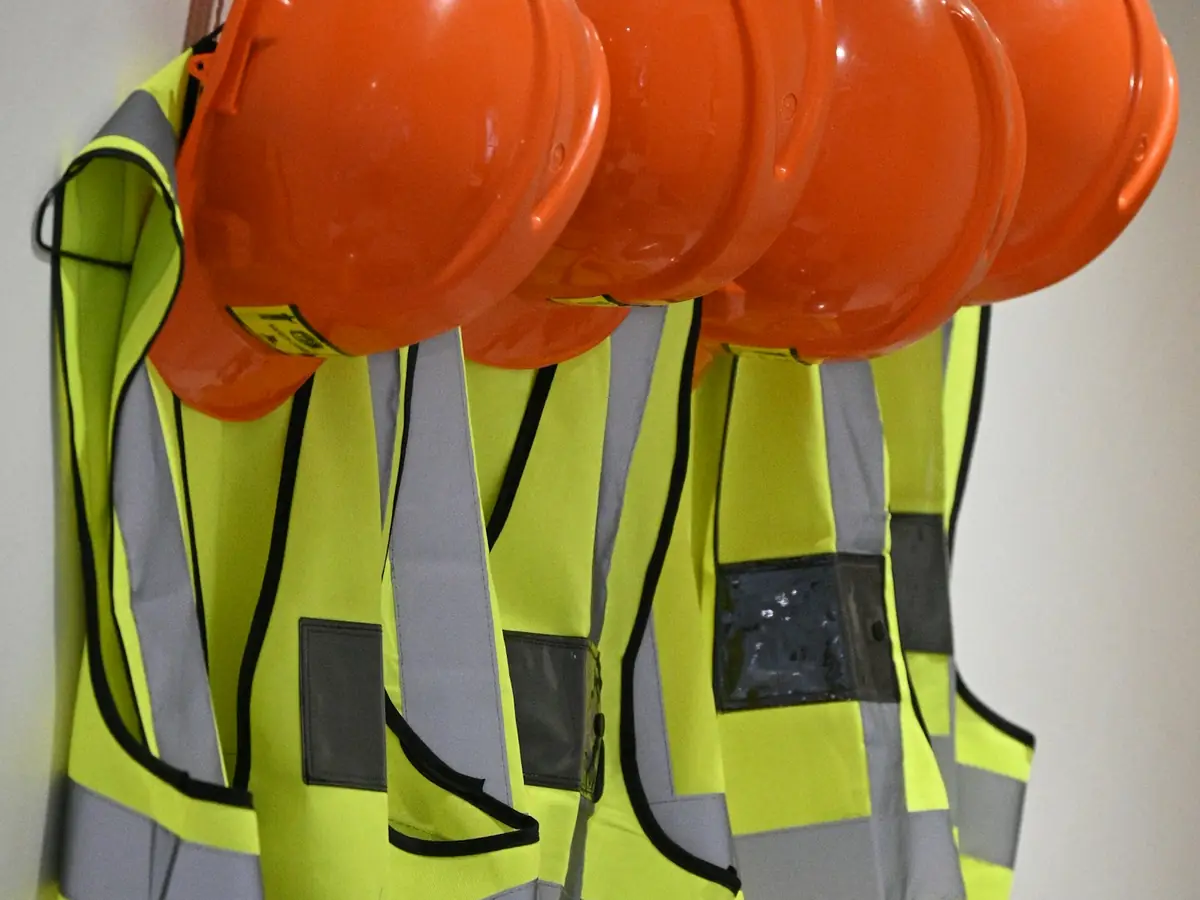
Give them a branded ANSI/ISEA 107 Class 2 or 3 shirt or vest, the class the federal traffic-control manual calls for near traffic. It doubles as advertising.
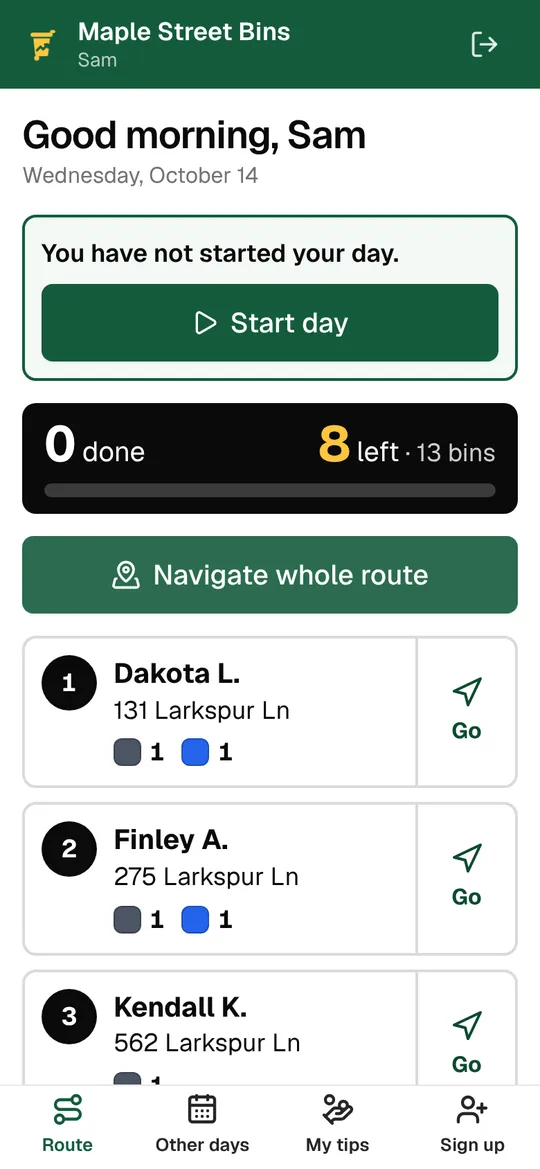
The stop on the technician’s phone
Example from Clean Bin System’s driver app: the route, then one stop with photos and its result.
The route checklist:
- Open: fluids checked; fresh tank full, wastewater tank empty; burner and pump tested; chemicals labeled with data sheets; gloves, tongs and sharps container; tablet charged and route loaded; holiday shifts checked.
- Each stop: confirm the truck passed, inspect, before photo, lift, wash, scrub, outside over the catch area, deodorize, drain, return, tag, after photo, result logged.
- Close: dump the cooled wastewater at the approved site, drain lines if it’s freezing, log engine hours, close every stop, restock.
When to add a second rig
| Trigger | From |
|---|---|
| Rig one grosses $12,000 to $15,000 a month for three months, with 60 to 80 customers waiting in a second area | A business guide (30DayPivot) |
| One route runs at about 80% of capacity | An operator quoted in a startup guide (JIM) |
None of these come from measured data. The principle behind all of them: the second rig should open with customers on it, not go looking for them. A rig sitting half full is the most expensive thing in this business (Lesson 7).
Real ways operators have grown:
- Mr. Clean Bins grew from one Florida city to three while keeping its office and trucks in the first one.
- Can Cleanse brought about 20 companies into its group in 18 to 20 months.
- The Bin Spa bought an existing route.
- The Trash Can Cleaners in San Antonio grew to more than 1,000 regular customers with five employees (Jobber case study).
The first three come from show notes of the Trash Chatter podcast, an industry podcast run by an equipment builder.
When to hire office help
We found no published threshold. What pushes it back is self-service and automation: customers who can skip, move, pause and update their card themselves, and reminders and failed-card follow-ups that send on their own. The practical signal is when calls, texts and billing questions keep you off the route or out of selling. Then part-time office help pays for itself.
Choosing software
What bin cleaning software should do:
- a sign-up page that takes a card;
- recurring billing with automatic retries and a card-update link;
- scheduling around trash days, with hauler holidays;
- route order and a driver app with photos;
- automatic texts and emails;
- a customer account to skip, move, pause and pay.
| Product | Built for | Listed price, October 2026 |
|---|---|---|
| Clean Bin System (ours) | Bin cleaning | $89, $179 or $329 a month; 1 technician on Starter, up to 4 technicians on Growth |
| Jobatory | Bin cleaning | $119, $199 or $349 a month; extra trucks $85 a month |
| Jobber | Any home service | Core $49 a month ($29 billed yearly), Connect $139 ($99), Grow $199 ($149) |
| GorillaDesk | Pest, lawn and pool | $49, $99 or $149 a month |
| MyRoutePro / Bindustry | Bin cleaning | Not checked |
Sources: Clean Bin System, Jobatory, Jobber, GorillaDesk. For a full comparison, see the best bin cleaning software in 2026.
What the market uses. Of the bin cleaning websites in our research, 80 book through Jobatory, 60 through Jobber, 33 through MyRoutePro or Bindustry, and 98 had no way to book online at all. Jobatory’s count is inflated, because many companies in the list came from its customer list.
A tip from an operator: when you compare tools, ask what happens at 100 or 200 stops a day. The Trash Can Cleaners picked its software that way.
The numbers to watch
| Number | How to work it out | What to aim for |
|---|---|---|
| Stops per route hour | Stops divided by hours from first stop to last, driving included | Up: about 2 an hour with 20-minute drives, 6 or more on a tight route (our model) |
| Money per route day | What the day’s stops billed | Our model: about $500 spread out, $1,100 to $1,500 tight |
| Completion rate | Stops cleaned divided by stops scheduled; count “not out” and “blocked” separately | No benchmark; watch the trend |
| Customers leaving | Cancellations this month divided by customers at the start of it | Each point matters: 3% a month keeps 69% for a year, 5% keeps 54% |
| Failed payments | Failed charges divided by attempted ones, and how many you recover | Retries and card-update links recover about half |
| Cost per paying customer | Marketing spend divided by new paying customers | Fresh Bins LA: $41 from Google Ads |
| Route fill | Customers on each route day against what it can hold | Fill a day before opening another |
| Cards on file | Customers on autopay divided by all customers | As close to all as you can |
Selling or buying a route
Bin cleaning routes do change hands. In October 2026 a South Carolina business with about 90 recurring customers was listed at $65,000, and a New Jersey one at $100,000 (BizBuySell). What a buyer looks at, and so what you should build: recurring customers with cards on file, tight routes, low cancellations, equipment in good shape, and contracts that transfer.
Key takeaways
- Hire when you’re turning customers away or your selling has stopped; try a second service day first.
- Route technicians are employees: plan on $16 to $22 an hour plus payroll costs, workers’ comp and training.
- Write checklists for the open, each stop and the close before your first hire.
- Add a second rig only when it can open with customers on it.
- Run on software built around trash days, and watch stops per hour, cancellations and cost per customer every month.
FAQ
When should I hire my first employee for bin cleaning?
When you’re turning down customers, your marketing has stopped because you’re always on the route, or you’re working 45-hour weeks month after month. Rules of thumb put it at about $12,000 to $15,000 a month in revenue or about 150 customers in a tight area. Try adding a second service day before adding payroll.
How much do bin cleaning technicians make?
Bin cleaning job ads in 2026 paid about $16 to $22 an hour. A Miramar, Florida ad offered $700 a week for 30 to 35 stops a day. Similar jobs have national medians of about $17 to $24 an hour, and your total cost is a few dollars an hour more after payroll taxes and insurance.
Can I pay bin cleaning technicians as 1099 contractors?
Almost certainly not. You decide the route, the method, the equipment and the uniform, which makes a route technician an employee under the IRS’s test. You can pay per stop or by the day, but overtime still applies past 40 hours.
What software do bin cleaning businesses use?
In our research, the most common booking tools on bin cleaning websites were Jobatory, Jobber and MyRoutePro or Bindustry, and about a quarter had no online booking. Bin cleaning software like Clean Bin System and Jobatory schedules around trash days; Jobber’s pricing page doesn’t mention trash-day or hauler-holiday scheduling.
When should I buy a second truck or trailer?
When your first rig is close to full and customers are waiting in a second area, so the second rig opens with a route already on it. A half-full financed rig loses money, so fill rig one and add service days first.